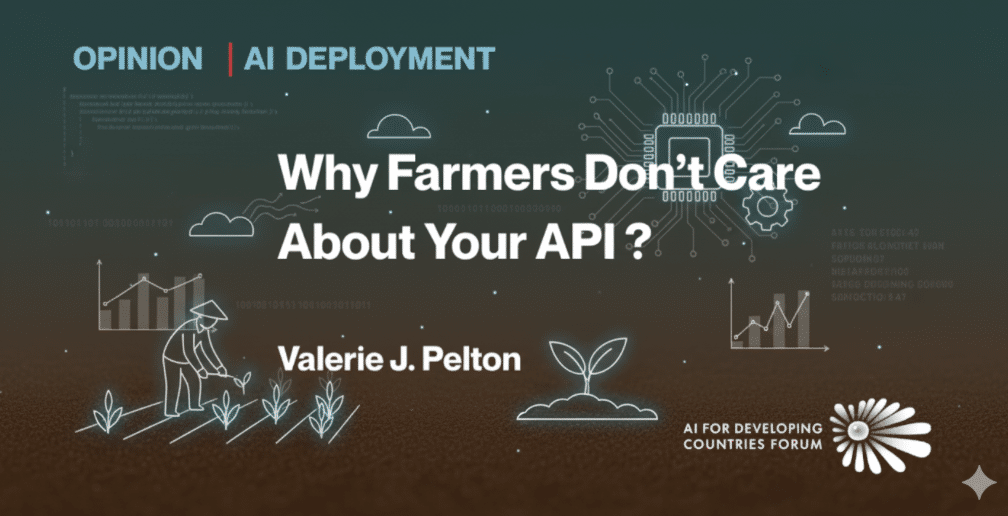
In an analysis published by AIFOD on 3 October 2025, biotech legal counsel Valerie J. Pelton evaluated the structural reasons agricultural artificial intelligence tools frequently fail when deployed in rural communities.
The Deployment Challenge
Advanced large language models offer theoretical benefits for rural producers, such as providing rapid mobile evaluations of crop weather, soil conditions, or pest infestations without forcing a farmer to travel to town or await postal reports. However, sophisticated cloud systems often collapse upon deployment in agricultural settings.
Pelton compared this to an international power adapter mismatch: systems engineered for robust cloud environments falter when confronting unstable connectivity, interfaces requiring literacy that users lack, or recurring fees exceeding rural household earnings. Furthermore, dependence on distant cloud vendors creates severe liabilities. When commercial subsidies lapse, communities risk getting stranded with expensive legacy platforms they cannot maintain. For rural producers facing sudden pest attacks or maritime emergencies, the latency of cloud processing and connectivity dropouts can cause catastrophic losses, alongside broader risks regarding data sovereignty and volatile vendor pricing.
Strategic Recommendations for Civil Society
Civil-society organisations and agricultural practitioners must design tools around prevailing field conditions rather than Silicon Valley assumptions:
- Prioritise Localised Models: Global systems trained on over a hundred languages struggle with regional nuances, such as distinctions between Gulf and Classical Arabic or formal and street Swahili. NGOs should deploy regional models built by non-profits or governments in 10 to 20 local languages, or fine-tuned community systems that deliver contextual accuracy.
- Ensure Operational Redundancy: Running local or offline-capable models shields farmers from internet outages and shifting commercial policies. Local deployment cuts latency, protects sensitive agricultural data, and lowers ongoing operational expenses.
- Design for Utility, Not Specifications: End users require functional outcomes, not lessons on application programming interfaces or underlying model architectures. Everyday tools should work reliably without technical exposition.
- Implement Resilient Connectivity: Projects must utilise pragmatic communications infrastructure suited to difficult terrain—such as satellite links, community mesh setups, or basic SMS messaging—rather than relying on high-speed internet availability.