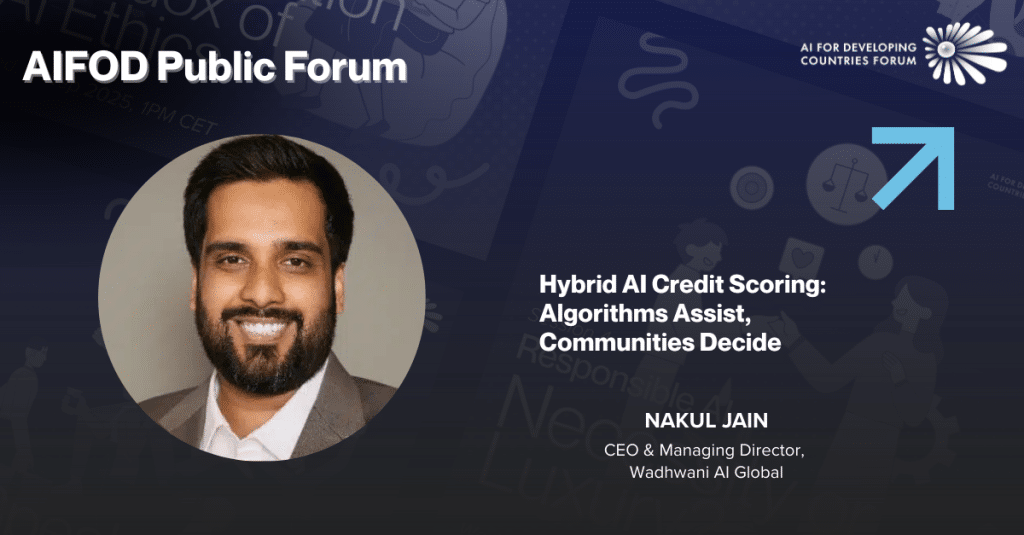
In an interview published by AIFOD, the organiser of the discussion on the cultural translation of credit, Nakul Jain, CEO and Managing Director of Wadhwani AI Global, detailed why standard digital credit models often fail in developing nations. Drawing on experience deploying over 40 artificial intelligence solutions reaching 150 million users across India and the Global South, Jain highlighted a fundamental mismatch: automated scoring tools built on individualistic Western financial frameworks assume single borrowers calculate repayments in isolation. In regions across South Asia and Africa, however, borrowing and repayment operate via collective accountability, familial ties, and mutual reputational standing.
When scoring models reduce multi-dimensional communal relationships into single digits, they create a bias by omission. Aspects of community life that cannot be quantified are ignored, stripping away the social reinforcement that motivates repayment. Jain pointed to tuberculosis healthcare reminders as an illustration: automated digital messages barely shifted adherence, whereas involving family networks and community healthcare workers produced dramatic improvements because behavioural change is inherently relational.
The Hybrid Architecture
To bridge this divide, Jain proposed a polycentric, three-tiered hybrid architecture that prioritises local leadership over automated authority:
- Local decision layers: Cooperatives, community bodies, and microfinance groups retain authority to assess trust and take final lending decisions.
- Algorithmic assistance: Machine learning tools analyse complex data environments, validate information, and surface insights to assist human judgment rather than replacing frontline workers.
- Interoperability frameworks: Translation systems enable diverse local models to coordinate across borders and regulatory jurisdictions.
For civil-society organisations and community lenders, the central takeaway is that algorithmic inclusion cannot be added as an afterthought during rollout. Instead, participatory inclusion must be embedded at program conception, data collection, model building, piloting, and subsequent evaluation. Automated calculations cannot fully capture local cultural or societal realities; algorithms must act strictly as decision-support systems that leave ultimate financial authority with communities.